
ROBOTIC SURGICAL SYSTEMS
The da Vinci Surgical Robot – A Medical Breakthrough?
Surgical robotics are an emerging technology, heralded as being revolutionary in the field of medicine. The first of its kind to be approved for use in surgery (in the year 2000) is named the da Vinci system, created by American company Intuitive Surgical. Through more than five million surgeries, they have become a leader in surgical robotics. Since then, a wide range of surgical robots have been developed, each specialising in different operations. The da Vinci robot has a surgeon sitting at a console and controlling three or four manoeuvrable arms to manipulate tissue in the human body and additional assisting doctors monitor the system’s diagnostics. It was created not only to improve success rates of surgery but also the ability to remotely control a surgical robot, which has applications in areas such as space and Antarctic exploration.
Technical Components
The da Vinci system consists of three main components:
The surgeon console is positioned away from the patient table and seats the surgeon operating, where they use hand controllers designed to simulate the movements made during surgery to manoeuvre the mechanical arms. By implementing a pressure sensor in the reducer (trocar), it can provide tactile feedback to the surgeon, allowing them to feel the pressure of tissue walls and tearing (Medgadget. 2019). The console provides an immersive display, using two cameras to surround the surgeon’s vision with 3D imaging, functioning similar to VR technology. At the surgeon’s feet are pedals that control energy application to specific instruments, and to their side is a touchpad to control video, audio, scaling and ergonomic settings.
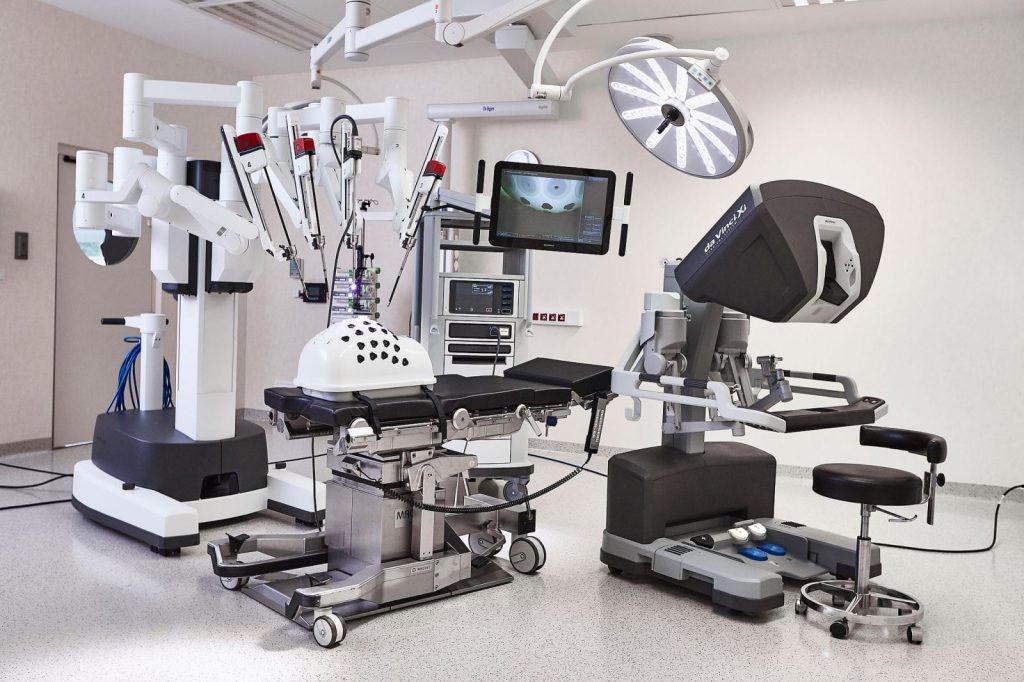
The patient-side cart is positioned next to the patient and uses three or four robotic arms controlled by the surgeon. Each arm can use one of several interchangeable instruments – the first of which consists of obturators and reducers. Obturators are used to create an opening incision at the surgery site, and a reducer is placed inside to open the incision and allow entry for other instruments. A range of sizes and blade-types are available to suit each instruments (Intuitive Surgical. 2017). After the obturator has served its purpose, it can be swapped out for another instrument, namely, the force bipolar – an all-purpose tool used to grasp tissue.
The third instrument is a laparoscopic stapler. Its primary function is to connect two pieces of tissue together with surgical staples (Johnson, Kassir, Marx, Soliman. 2019). What is innovative about the da Vinci’s model is its ability to monitor compression and automatically adjust the amount of force applied to create a consistent row of staples and prevent tissue damage (Intuitive Surgical. 2017).
Another instrument is an electrical device, used to grasp, seal, cut and coagulate tissue by applying either bipolar or monopolar electro-energy. These are high-frequency electrical currents which, when applied to organic tissue, produce heat (Bovie. 2019). The energy is generated and controlled by an external machine named the E-100 Generator; surgeons can use the generator’s interface to adjust the energy output and the amount of coagulation, cutting or sealing power applied.
Whether the grape was in need of surgery or not is debatable, but successfully performing surgery on such a delicate and slippery object is a testament to the capabilities of robotics.
The fifth instrument is an endoscope that offers a wide range of magnification options, light modes and a HD camera with true depth perception and 3D rendering. It is capable of magnifying images up to 15 times the naked eye, allowing surgeons to view structures in fractions of a millimetre scale (Kaynan. 2015). Furthermore, it can swap between using regular light and near-infrared light – the former being used for general surgical processes and the latter for fluorescing specific tissue structures or organs (Boni et. al. 2015) with the use of an indocyanine green dye (ICG). This allows surgeons to identify specific structures, for example, a tumour in the lymph nodes. The endoscope includes software named Iris used to visualise anatomical structures which can be projected on Apple iOS and other devices. Using CT scans, Iris can create a 3D model of the patient’s anatomy, allowing surgeons to interact with and plan the surgical approach. Furthermore, all instruments have greater articulation than the human hand, able to rotate and move freely within a 120-degree cone.
The vision cart features a touchscreen monitor that relays video from the endoscope and houses the system’s central processing unit (CPU). All actions made by the surgeon are sent to the CPU which processes it and initiates the proper response (Silwen. 2019). The vision cart also contains shelves to store various ancillary surgical equipment such as the E-100 and insufflators.
Prospects in Space
The idea of robotic surgery originated in a NASA research paper from the early 1980s, proposing the use of tele-surgery for astronauts in space. NASA pushed this idea further in 1984, collaborating with a team from Memorial Medical Centre in Long Beach and robot company Unimation to build the Puma 200 – a mounted robotic arm connected to a CT scanner table (Fiorini. 2018, p. 8). It’s function was to guide a biopsy cannula (needle) through the brain by using images from a CT scan to orient itself (Eljamel. 2008, p. 42). This was achieved in 1985 using a 52-year old male patient. In the late 1980s, development of robotic surgery was primarily conducted by the US Army, which funded SRI International’s development of a prototype robotic surgical system experimenting with animal surgeries. The rest of the late 20th Century experienced a surge of medical centres and universities experimenting with this technology, progressing its capabilities and eventually leading to the creation of the first FDA approved robotic surgical robot – the da Vinci system in the year 2000.
Altering Society as we have Come to Know it
Robotic surgery systems are still a relatively new invention and technology is constantly progressing, yet they have the potential to improve society as a whole. The immediate benefits when operating on patients would be incredibly precise movements and reduction of complications, ultimately decreasing blood loss and improving their recovery time. A greater turnover of patients would significantly reduce expenses incurred from housing them and allow for more patients to be treated. There is however, an immediate expense – the cost of the system being two million dollars impacts whether hospitals and Governments are able to afford it, making it difficult for developing countries to gain this technology. In countries with limited specialist surgical resources or in a country like Australia where health care is unevenly distributed in rural areas, such remote robotic tele-surgery has the potential to provide surgical services to a greater number of patients. Surgical procedures have been conducted directly by humans for thousands of years, and remain the predominant approach; with the introduction of robotic surgery this is slowly starting to change, paving the way for significant advances in the medical industry.
References
Ayal M. Kaynan 2015, Advantages of Robotic Surgery, America New Jersey Robotic Urologic Surgery, Retrieved 7 May 2020, http://roboticurologicsurgery.com/robotic-surgery/advantages-of-robotic-surgery/
Boni, L; David, G; Mangano, A; Dionigi, G; Rausei, S; Spampatti, S; Cassinotti, E & Fingerhut, A 2015, Clinical Applications of Indocyanine Green (ICG) Enhanced Fluorescence in Laparoscopic Surgery, Springer International, America
Bovie 2019, Monopolar Electrosurgery vs. Bipolar Electrosurgery, South America Tennessee Symmetry Surgical, Retrieved 7 May 2020, http://www.boviemedical.com/2016/10/03/bipolar-electrosurgery-vs-monopolar-electrosurgery/
EdwardHospital 2010, da Vinci Surgical System: Surgery on a Grape, Retrieved 1 June 2020, https://youtu.be/KNHgeykDXFw
Fiorini. P 2018, ‘The Development of Surgical Robots’, in Y Fong, Y Woo, WJ Hyung & VE Strong (eds), The SAGES Atlas of Robotic Surgery, Springer International, America
Intuitive Surgical 2017, da Vinci Energy SynchroSeal Vessel Sealer Extend E-100 Generator, Intuitive Surgical, America California
Intuitive Surgical 2017, da Vinci XI Surgical System First Access Accessories Streamline the Start, Intuitive Surgical, America California
Johnson, CS; Kassir, A; Marx, DS & Soliman, MK 2019, Performance of da Vinci Stapler During Robotic-assisted Right Colectomy with Intracorporeal Anastomosis, America Oklahoma
Medgadget 2019, da Vinci Surgical Robot Given Sense of Touch to Prevent Injury, Medgadget, America Oregon
M. Sam Eljamel 2008, ‘Robotic Applications in Neurosurgery’, in V Bozovic (eds), Medical Robots, IntechOpen, Rijeka, Croatia
PMR Healthcare Market Experts 2019, Szipital na Klinach: The Seventh da Vinci Robot in Poland, image, Retrieved 1 June 2020, https://healthcaremarketexperts.com/en/news/szpital-na-klinach-the-seventh-da-vinci-robot-in-poland/
Silwen 2019, What Are the Main Functions of a CPU?, Turbo Future, Europe
By Simon Daley